Data Structures. Trees
27 ноября 2023 г.
This is a short expanded summary of the section about trees in the book Computer Science Guide by William Springer.
Basic information
A tree is simply a connected graph with no cycles. One vertex is designated as the root, and all other vertices are defined by their relationship to the root.
An example of a tree is the DOM tree.
The following definitions are equivalent for a tree:
- an acyclic graph in which adding any edge creates a simple cycle (a cycle with no repeated vertices);
- a connected graph that becomes disconnected if any edge is removed;
- a graph in which any two vertices are connected by a unique simple path.
Types of nodes
A tree has two types of nodes:
- internal nodes — nodes with at least one child
- leaves — nodes with no children
Below is an example of a tree with ten vertices and one internal node.
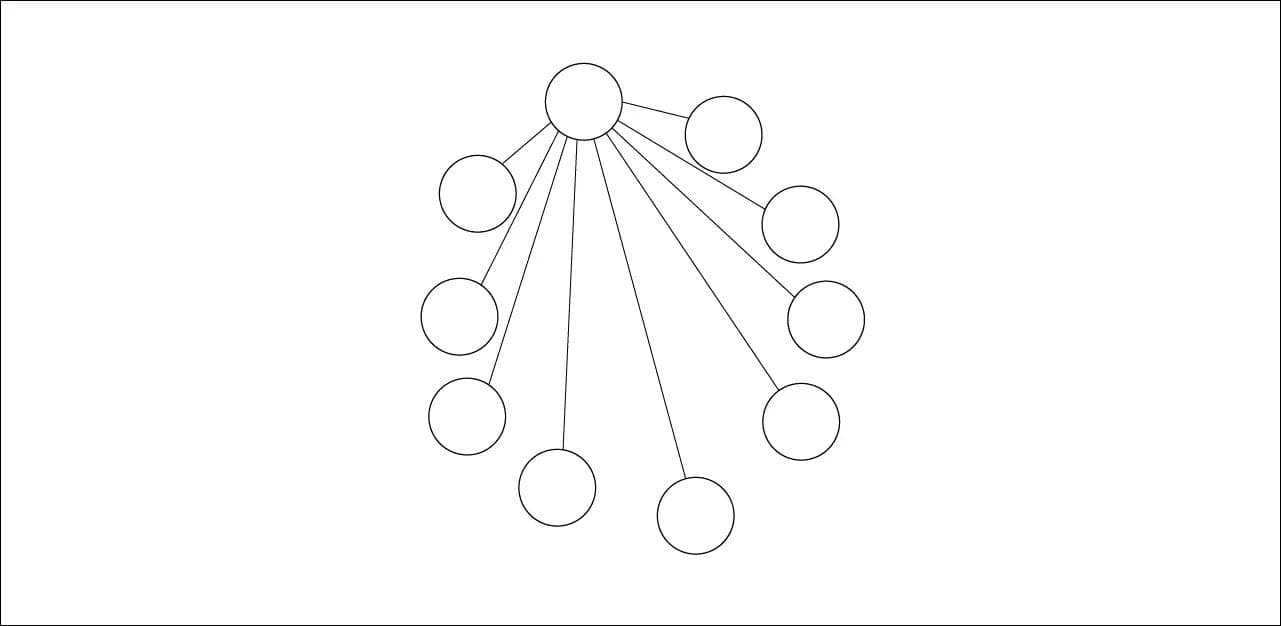
Besides binary trees, trees with four nodes (quadtrees) are also widely used in practice. They are used in game development to organize grids. Each node in such a tree represents one direction (northwest, southeast, and so on).
Basic operations
- add a node (add)
- remove a node by value (remove)
- find a node by value (find)
- traverse all elements (traverse)
If needed, this list can be extended with more complex algorithms:
- insert/remove subtree
- insert/remove branch
- insert element at a specific position
- find lowest common ancestor of two nodes
JavaScript implementation
Array-based representation
(Example taken from a reference site)
[3, 2, [3, 8], [[8], 3]];
Where:
- the entire array is the root
- elements are children
- a non-array child is a leaf
- an array child is an internal node with its own children
Node-based representation (linked structure)
(Example taken from this website)
1class BinaryTreeNode {2 constructor(value) {3 this.left = null;4 this.right = null;5 this.parent = null;6 this.value = value;7 }89 get height() {10 let leftHeight = this.left ? this.left.height + 1 : 0;11 let rightHeight = this.right ? this.right.height + 1 : 0;12 return Math.max(leftHeight, rightHeight);13 }1415 // When inserting, it is important to update all affected references: left or right for the parent node and parent for the child node. If the parent already had a child, its parent property should be set to null.161718 setLeft(node) {19 if (this.left) {20 this.left.parent = null;21 }22 if (node) {23 this.left = node;24 this.left.parent = this;25 }26 }2728 setRight(node) {29 if (this.right) {30 this.right.parent = null;31 }32 if (node) {33 this.right = node;34 this.right.parent = this;35 }36 }37}38let aNode = new BinaryTreeNode('a');3940let bNode = new BinaryTreeNode('b');41aNode.setLeft(bNode);4243let cNode = new BinaryTreeNode('c');44aNode.setRight(cNode);4546let dNode = new BinaryTreeNode('d');47bNode.setRight(dNode);4849let eNode = new BinaryTreeNode('e');50cNode.setLeft(eNode);5152let fNode = new BinaryTreeNode('f');53cNode.setRight(fNode);
Binary Search Trees (BST)
A Binary Search Tree (BST) is a rooted binary tree where each node has at most two children.
It is defined recursively:
- the root key is greater than or equal to the left child key (if it exists)
- the right child key is always greater than or equal to the root key
This ordering makes searching efficient because half of the tree can be ignored at each step.
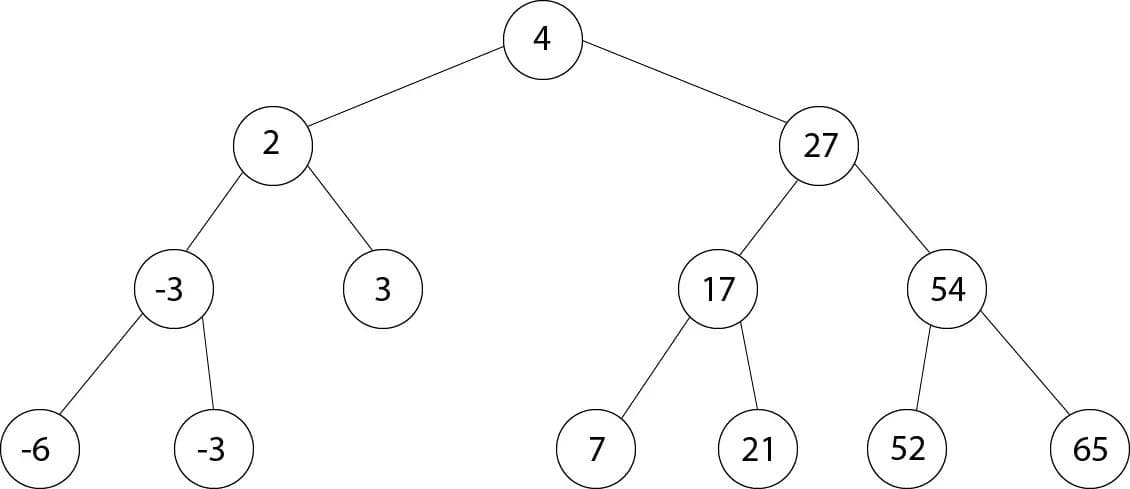
Time complexity is proportional to tree height — the length of the longest path from root to leaf.
In the general case, this is Θ(lg n).
The Θ notation means that the execution time is bounded both from above and below; the height of the tree must be at least lg n.
In the worst case (when each node has only one child, which essentially turns the tree into a linked list — an unbalanced binary search tree), the complexity is O(n).
Below is an example of an unbalanced binary tree.
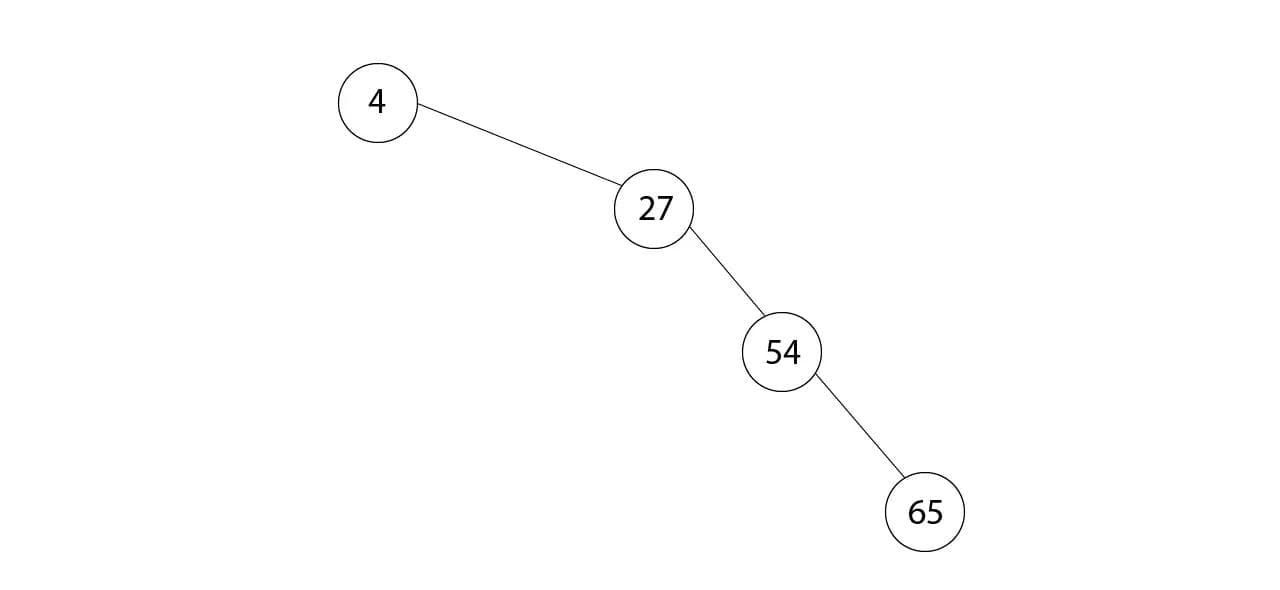
A binary search tree can be implemented as a collection of linked nodes — each node contains a key and pointers to the left and right child nodes, as well as to the parent node.
JavaScript implementation
The examples are taken from this website.
The first added node becomes the root of the tree.
Next, we compare the value of the new element with the value of the parent node. If it is greater, we place the element in the left branch; if it is smaller, we place it in the right branch.
Adding an element
We build the tree in the same way as in the previous example, but this time we add a new method for inserting elements. This method compares values and places the element into the appropriate branch.
1class BinarySearchTreeNode extends BinaryTreeNode {2 constructor(value, comparator) {3 super(value);4 this.comparator = comparator;5 }67 insert(value) {8 if (this.comparator(value, this.value) < 0) {9 if (this.left) return this.left.insert(value);10 let newNode = new BinarySearchTreeNode(value, this.comparator);11 this.setLeft(newNode);1213 return newNode;14 }1516 if (this.comparator(value, this.value) > 0) {17 if (this.right) return this.right.insert(value);18 let newNode = new BinarySearchTreeNode(value, this.comparator);19 this.setRight(newNode);2021 return newNode;22 }23 return this;24 }25}2627class BinarySearchTree {28 constructor(value, comparator) {29 this.root = new BinarySearchTreeNode(value, comparator);30 this.comparator = comparator;31 }3233 insert(value) {34 if (!this.root.value) this.root.value = value;35 else this.root.insert(value);36 }37}3839const comparator = (a, b) => a - b;40/*41If 0 is returned, it means that the numbers are equal;42if a negative number is returned, it means the value is less than the target value;43if a positive number is returned, it means the value is greater than the target value.44*/4546const tree = new BinarySearchTree(14, comparator);47tree.insert(9);48tree.insert(124);49tree.insert(3);50tree.insert(19);51tree.insert(45);52tree.insert(1);53tree.insert(8);54tree.insert(59);
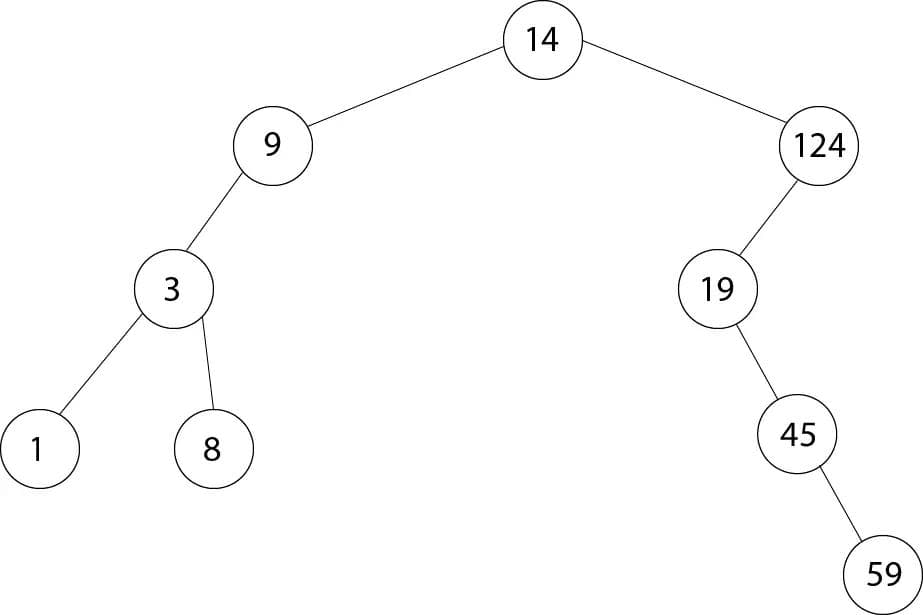
All new values greater than the root go to the left branch, while smaller values go to the right branch. Therefore, the tree in the example above should look like this:
Deleting an element
To delete a node d, we need to find it in the tree and then perform the following steps:
- If
dhas no children — set the pointer of the parent node that currently referencesdtonull. - If
dhas one child — the child takes the place ofd. - If
dhas two children — find the next node in order (the minimum node in the right subtree of the node being deleted) and replacedwith it.
1// Add helper methods to the BinarySearchTreeNode class2class BinarySearchTreeNode extends BinaryTreeNode {3 // ...45 // Find the minimum element in the subtree6 findMin() {7 if (!this.left) {8 return this;9 }1011 return this.left.findMin();12 }1314 // Remove the specified element if it is a child of this node.15 removeChild(nodeToRemove) {16 if (this.left && this.left === nodeToRemove) {17 this.left = null;18 return true;19 }2021 if (this.right && this.right === nodeToRemove) {22 this.right = null;23 return true;24 }2526 return false;27 }2829 // Replace a child element with a new one.30 replaceChild(nodeToReplace, replacementNode) {31 if (!nodeToReplace || !replacementNode) {32 return false;33 }3435 if (this.left && this.left === nodeToReplace) {36 this.left = replacementNode;37 return true;38 }3940 if (this.right && this.right === nodeToReplace) {41 this.right = replacementNode;42 return true;43 }4445 return false;46 }47}4849// Add the remove method to the BinarySearchTree class50class BinarySearchTree {51 //...5253 remove(value) {54 const nodeToRemove = this.find(value);5556 if (!nodeToRemove) {57 throw new Error("Item not found");58 }5960 const parent = nodeToRemove.parent;6162 // No children, leaf node63 if (!nodeToRemove.left && !nodeToRemove.right) {64 if (parent) {65 // Remove the pointer to the deleted child from the parent node66 parent.removeChild(nodeToRemove);67 } else {68 // No parent, root node69 nodeToRemove.value = undefined;70 }71 }7273 // Has both left and right children74 else if (nodeToRemove.left && nodeToRemove.right) {75 // Find the minimum value in the right subtree76 // And place it in the position of the deleted node77 const nextBiggerNode = nodeToRemove.right.findMin();7879 if (this.comparator(nextBiggerNode, nodeToRemove.right) === 0) {80 // The right child is also the minimum value in the right subtree,81 // meaning it has no left subtree.82 // We can simply replace the deleted node with its right child.8384 nodeToRemove.value = nodeToRemove.right.value;85 nodeToRemove.setRight(nodeToRemove.right.right);86 } else {87 // Delete the found node (recursion)88 this.remove(nextBiggerNode.value);89 // Update the value of the node being deleted90 nodeToRemove.value = nextBiggerNode.value;91 }92 }9394 // Has only one child (left or right)95 else {96 // Replace the deleted node with its child97 const childNode = nodeToRemove.left || nodeToRemove.right;9899 if (parent) {100 parent.replaceChild(nodeToRemove, childNode);101 } else {102 this.root = childNode;103 }104 }105106 // Remove the reference to the parent107 nodeToRemove.parent = null;108109 return true;110 }111}112
Balanced Binary Search Trees
A self-balancing binary search tree is a tree that automatically maintains a small height (compared to the number of required levels), regardless of adding or deleting nodes.
Its height can be greater than the minimum possible height, but it will still be Θ(lg n).
- Red-Black Tree — All keys are stored in internal nodes, while the leaves are null (NIL) nodes. Each node is either red or black: the root and all leaves are black, and the children of a red node must be black. Every path from a node to any leaf must contain the same number of black nodes. The path from the root to the farthest leaf is at most twice as long as the path from the root to the nearest leaf. This is because the shortest possible path consists entirely of black nodes, while the longest possible path alternates between red and black nodes. As a result, no path can be more than twice as long as any other.
- Splay Tree
- Treap (Cartesian Tree)